To check cosmetic ingredients without relying on a single score, match the app result to the product in your hand, read the full ingredient list, and open the explanation behind each flag. Check what the rating measures and what information is missing. A number can help you find questions to investigate; it cannot tell you exactly how your skin will react.
ALVA helps you look beyond a product score with ingredient information and a personalised analysis that includes an explanation of potential concerns.
Start with the question, not the colour
A red badge, a green tick and a percentage may look comparable, but they do not necessarily answer the same question. Before acting on a result, decide what you need to know: does this product list an ingredient you have been advised to avoid, what does an unfamiliar ingredient do, or why did the app flag it?
For example, Yuka explains that its cosmetic rating is driven by the highest-risk ingredient in its classification, with other ingredients affecting the score within that range. That is a published scoring method, not a personal diagnosis. Read the methodology of whichever app you use, including ALVA, before treating its number as an answer about you.
1. Make sure you are looking at the right product
Compare the brand, full product name and variant with the packaging. Then compare the ingredient list. If a result describes a different version, or the ingredients do not match, pause before using its score to make a decision.
For a product missing from an app, check the packaging and the manufacturer’s current product information. Ask the manufacturer if the two disagree. An absent database entry is missing information; it is not evidence that the product is either safe or unsafe.
2. Read the explanation behind the flag
Look for the specific ingredient named, the concern being raised and the evidence offered. Can you trace the explanation to a source? Does it describe a general concern or explain its relevance to this particular product? If a result cannot answer those questions, record the uncertainty instead of filling in the gaps yourself.
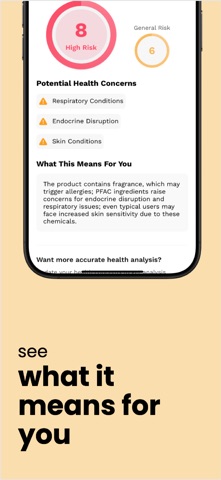
ALVA’s official screenshots show a personalised analysis with a section explaining what the result means for the user. Use that explanation as a starting point for checking the ingredient and its context. The example below shows the app’s presentation; it is not independent validation of the health claims shown.
3. Notice what the label cannot tell you
An ingredient name alone does not describe the whole formulation. For one concrete example, the FDA explains that the exfoliating effect of alpha hydroxy acids depends on the acid, its concentration, the product’s pH and other ingredients. A list of names does not necessarily provide all of that information.
There can also be limits to ingredient disclosure. On US cosmetic labels, fragrance mixtures may be listed simply as fragrance rather than naming every component, as the FDA’s fragrance guidance explains. Labelling rules differ by market, so do not assume a US label and a UK label follow identical requirements. If the detail you need is missing, ask the manufacturer rather than treating an app’s silence as confirmation.
4. Keep personal concerns separate from general ratings
A general product rating and a personal suitability score are different kinds of information. Neither replaces advice about an ingredient you already know causes you a problem. Keep the exact ingredient names and any avoidance advice given by your clinician available when comparing products.
The NHS explains that contact dermatitis can involve irritants or allergens, including substances in cosmetics. It advises seeing a GP for persistent, recurrent or severe symptoms. A high app score is not a reason to dismiss symptoms, and a low score does not identify their cause.
A useful checklist to take shopping
- Match: Is this the exact product and ingredient list on the packaging?
- Meaning: Is the number about general ingredient concerns, environmental effects or personal suitability?
- Explanation: Which ingredient triggered the flag, and can I check the source?
- Missing details: Does the result depend on information I do not have?
- Next step: Can I resolve the question from the label, or should I ask the manufacturer or a health professional?
You can use this checklist with an app you already like. There is no need to change tools solely because two numbers differ. If you want to explore ALVA’s approach, read about ALVA and check its current iPhone listing for availability and purchase details.
MEET ALVA
Look beyond the score.
Explore ingredient information and the explanation behind your personalised analysis.
See the App Store for availability and purchase details.
Why we wrote this guide
Our September 2026 review research found three UK App Store reports across OnSkin and SkinSort describing confusion or disappointment with suitability scores. These are individual accounts, not verified defects, proof of medical causation or a measure of how often a problem occurs. They prompted this practical guide, not a claim that one app’s scores are more accurate than another’s.